Dwelling on Past Mistakes › Submodalities
Submodalities for Dwelling on Past Mistakes
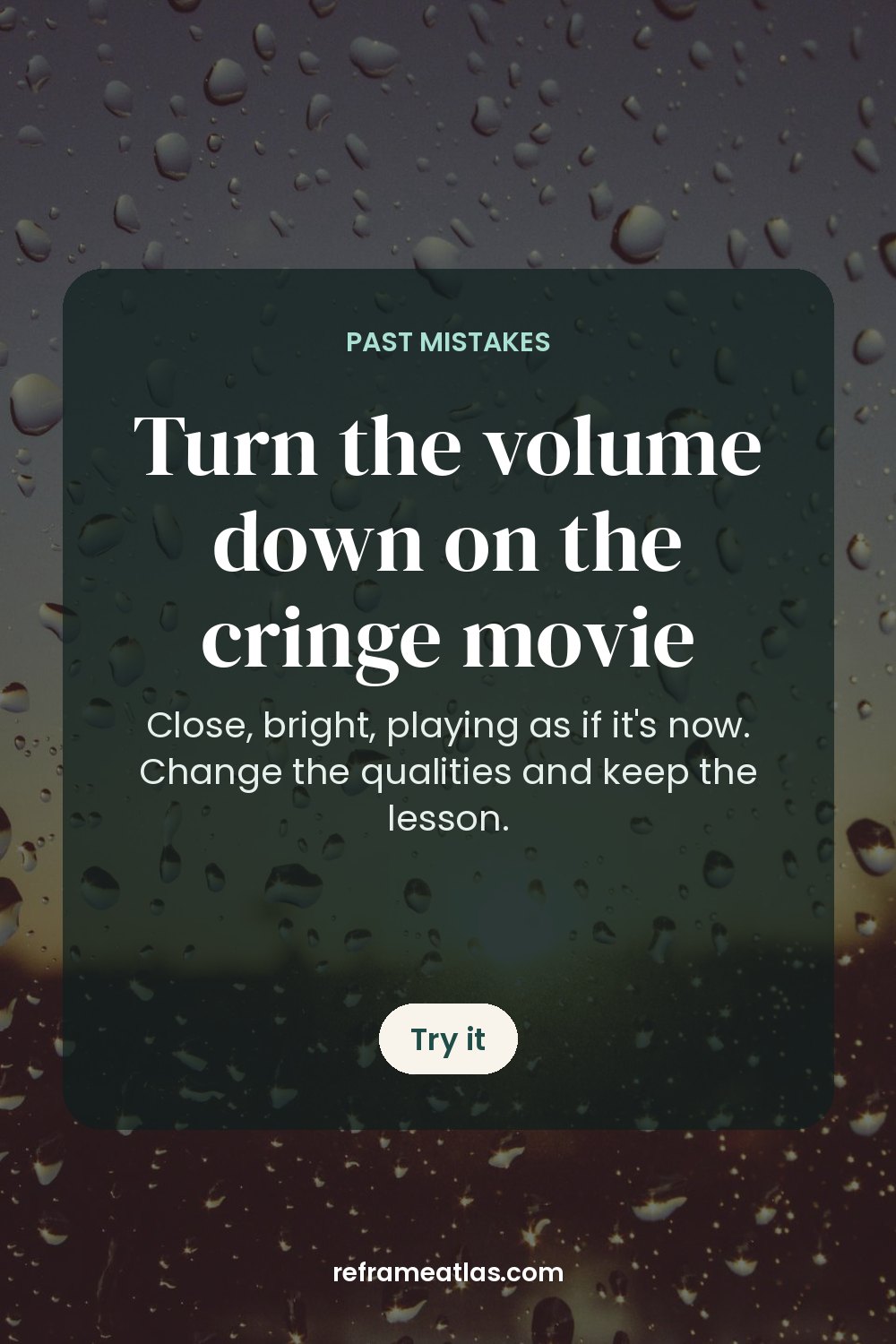
In short: A mistake that won't leave usually isn't just a thought. It's a movie: close, bright, in color, maybe with the sound of your own cringe, playing as if it's happening now. Submodalities are those qualities of the memory. Changing them doesn't erase what you learned. It often turns the volume down so you can keep the lesson without the late-night replay.
Why dwelling on past mistakes sticks
Your feelings respond to how the memory is coded, not only to what happened. A close, life-size replay feels urgent. The same facts, seen smaller and further away, usually feel more like something from the past. Willpower rarely changes the coding. Directly changing size, distance, color, and sound often does.
Why submodalities fits
Submodalities give you dials. You push the picture back, shrink it, drain some color, step out so you see yourself in it rather than through your own eyes, and quiet the soundtrack. Many people find the rating of distress drops within a few minutes, while the useful lesson is still clear.
Before you start: find these first
- One specific mistake memory. The scene that loops. One at a time.
- A 0 to 10 scale. You'll rate before and after.
- Five quiet minutes. Eyes closed helps, but isn't required.
Steps
- Bring up the memory. Notice: how big, how close, how bright, color or black and white, still or moving, any sound? Are you looking through your own eyes?
- Rate how strong the sting feels, 0 to 10.
- If you're in your own eyes, step out so you can see yourself in the picture, like watching a clip of you.
- Push the picture further away and make it smaller, about the size of a photo on a far wall.
- Drain some color until it's a bit washed out, or turn it black and white.
- If there's sound (your voice, their voice, a crunch of embarrassment), turn it down, slow it, or move it further away.
- Put a simple title under the picture, like a caption: "Lesson: pause before I answer when I'm boiling."
- Re-rate. Stop around 4 or lower, or when it feels clearly past.
Say it like this
Read it slowly, out loud or in your head, and swap in your own cue.
"The memory: snapping at my sister on the phone. It's right in front of my face, full color, I can hear my sharp voice."
"Sting: 8. I'm in my own eyes."
"Stepping out. Now I can see myself at the kitchen counter with the phone."
"Pushing it back to the far wall. Smaller, like a photo."
"Color fading a bit. My sharp voice is quieter, further away, a little slower."
"Caption under it: "Lesson: say can I call you back when I'm already boiling.""
"Sting: 3. I still know what I did. It isn't grabbing me the same way."
Keep the caption. Turning the picture down without keeping the lesson can leave part of you worried the mistake will repeat, and the loop returns.
Bring up one looping mistake. Notice how close and bright it is. Step out of your own eyes, push it back, shrink it, quiet the sound, and add a one-line lesson caption. Re-rate.
How to tell it's working
- The memory is harder to make huge and close again.
- Your rating drops by a few points.
- It feels more like then than like now.
- You can recall the lesson without the full-body cringe.
- Night replays are shorter or less frequent.
Common mistakes
- Erasing the memory. Don't make it disappear. Turn it down and keep the lesson.
- Staying in your own eyes. Associated (through your own eyes) keeps it feeling current. Step out.
- Working on a traumatic scene alone. If it's overwhelming, stop and get support.
- Skipping the re-rate. The number tells you which changes helped.
- Changing everything at once with no lesson. Add the caption so your mind knows the useful part is kept.
If it's not working
"I can't really see pictures."
Work with sound and feeling instead. Where is the cringe in your body? How loud is the voice? Move the voice away and soften the body feeling.
"It pops back full size tomorrow."
That's common. Repeat the sequence a few times, then try <a href="/nlp/reframing-for-dwelling-on-past-mistakes/">Reframing for Dwelling on Past Mistakes</a> so the meaning matches.
"I keep asking why I did it."
Try <a href="/nlp/meta-model-for-dwelling-on-past-mistakes/">Meta Model for Dwelling on Past Mistakes</a>.
"It still feels like it's on my timeline as now."
Try <a href="/nlp/timeline-for-dwelling-on-past-mistakes/">Timeline for Dwelling on Past Mistakes</a>.
When to use something else
- Traumatic or overwhelming memories. If the scene floods you, please work with a licensed professional rather than alone.
- When shame is constant. If you feel worthless most days, get support. This is for turning one replay down, not for treating depression.
- When amends are still needed. Softening the picture doesn't replace apologizing or repairing.
For coaches: using submodalities with clients
With an ideal client, map the qualities of the memory before changing anything. Ask size, distance, color, association, and sound. Let them make one change at a time and re-rate after each, so they learn which dial matters most. Always end with a lesson caption in their words.
- Elicit one specific looping mistake.
- Map submodalities and get a 0 to 10 rating.
- Have them dissociate if associated.
- Change distance, size, color, and sound one at a time.
- Add their lesson caption.
- Re-rate and note which changes mattered most.
Say it like this, with a client
"When you think of that mistake, what do you see? How close is it?"
"Are you looking through your own eyes, or can you see yourself in it?"
"How strong is the sting, 0 to 10?"
"What happens if you step out and push the picture to the far wall?"
"And if the sound gets quieter and further away?"
"What one-line lesson belongs under that picture?"
"What's the number now?"
The reframe
Old frame: "I can't believe I did that, I should have known better"
New frame: I made the best choice I could with what I knew then; the lesson is mine to keep, and the shame isn't.
Other NLP techniques for dwelling on past mistakes
- Timeline Work for Dwelling on Past Mistakes
- Reframing for Dwelling on Past Mistakes
- Perceptual Positions for Dwelling on Past Mistakes
- The Meta Model for Dwelling on Past Mistakes
Submodalities for other problems
- Submodalities for Procrastination
- Submodalities for Self-Doubt
- Submodalities for Overthinking
- Submodalities for Lack of Motivation
- Submodalities for Negative Self-Talk
- Submodalities for Fear of Rejection
- Submodalities for Comparing Yourself to Others
- Submodalities for Racing Thoughts at Night
- Submodalities for Test and Exam Anxiety
- Submodalities for Creative Block
Related techniques
Swish Pattern · Anchoring · Timeline Work
FAQ
What are submodalities in NLP?
The qualities of how you picture or hear something, such as size, distance, brightness, color, and volume.
Can this help me stop replaying mistakes?
Many people find that turning those qualities down softens the sting while the lesson stays clear.
Will I forget what I learned?
Not if you keep a lesson caption. The point is less sting, not less learning.
What if I can't visualize?
Use sound and body feeling. Location, loudness, and intensity can change too.
How long does it take?
About five minutes. Repeat a few times for the same memory.
Is this therapy?
No. It's a self-reflection tool from neuro-linguistic programming, not therapy or medical advice.
The ReframeAtlas Script Pack is a 40-page PDF with step-by-step NLP scripts, reframe cards, and a technique quick reference for 12 everyday problems, including racing thoughts at night, people-pleasing, overthinking, and self-doubt. Instant download, $19.
Background
Developed by Richard Bandler in the early 1980s; see Using Your Brain for a Change.
Sources and further reading
- Neuro-linguistic programming - Wikipedia
- Source materials for NLP methods - Andreas NLP
- NLP skills and protocols list - dailyNLP
These exercises are self-reflection tools, not therapy or medical advice. If something is seriously affecting your life, please talk to a licensed professional.
Last updated 2026-11-06